I oversee site preparation and excavation on our builds, and on a rural lot the well is part of that stage. People tend to frame dug versus drilled as a preference. More often, the ground under the lot has already made the choice, and the useful thing is understanding why.
Two wells, built two different ways
Ontario’s factsheet on private rural water supplies describes both types, and the numbers explain most of what follows.
- A dug well is a wide hole, 60 to 120 cm across, lined with concrete tile or corrugated steel. Today it is dug with an excavator, and it is usually no more than 9 m deep. A bored well is the same idea, made with a boring machine; the average is about 15 m, and some reach 30 m.
- A drilled well is a narrow, watertight casing, 10 to 20 cm across, set in a drilled hole. It draws either from sand and gravel above the bedrock or from the bedrock itself.
So one is a wide, shallow reservoir that fills from the groundwater near the surface. The other is a narrow, sealed pipe that reaches down to water much further from anything happening on top of the ground.
Why a drilled well is harder to contaminate
Every well is a hole from the surface straight down to your drinking water. What matters is whether water from the surface can follow that hole down.
The provincial factsheet is direct about it: large-diameter wells in general are more vulnerable to contamination than drilled wells. The reasons are mechanical. A dug well has joints between its tiles that can leak, and the space around the outside of a wide casing is hard to seal properly with grout. A drilled well’s casing is watertight, with welded or sealed joints, and it is often cemented where it meets the bedrock. That construction is what makes it less vulnerable than other well types.
Older dug wells lined with brick, stone or wood cribbing are the most exposed, because surface water can seep through the lining above the water table.
A dug well drinks from the top of the water table
A dug well’s water is the water closest to the surface. That makes it the first to change when the surface does.
Ontario’s guidance on testing private wells notes that in wells less than 3 m deep, water quality can change within hours or days of a rainstorm or a thaw. The rural water factsheet adds that very shallow large-diameter wells can run low during long dry spells. Properly built deeper wells tend to have more stable water levels, though their quality can still change over time.
A dug well does have one thing going for it. Its width means it stores a large volume of water, which can carry a household through a busy morning even where the ground refills it slowly. Where a good, clean, shallow water supply exists, a dug well in sound condition can do the job. It just asks more of its owner: a tight cover, testing, and attention to what happens on the ground around it.
On Shield rock, the choice is usually made for you
Much of Central Ontario’s cottage country sits on the Canadian Shield, and across Muskoka bedrock is often close to the surface. A dug well needs a depth of water-bearing soil to dig into. Where granite is a metre or two down, there is nothing to dig, and the water is in fractures in the rock. That is drilled-well country.
Off the Shield, where the ground is deep sand and gravel, a drilled well may find water in that overburden without ever reaching rock. A dug well is at least possible there too. The question becomes the depth of the water table and what else is on the lot.
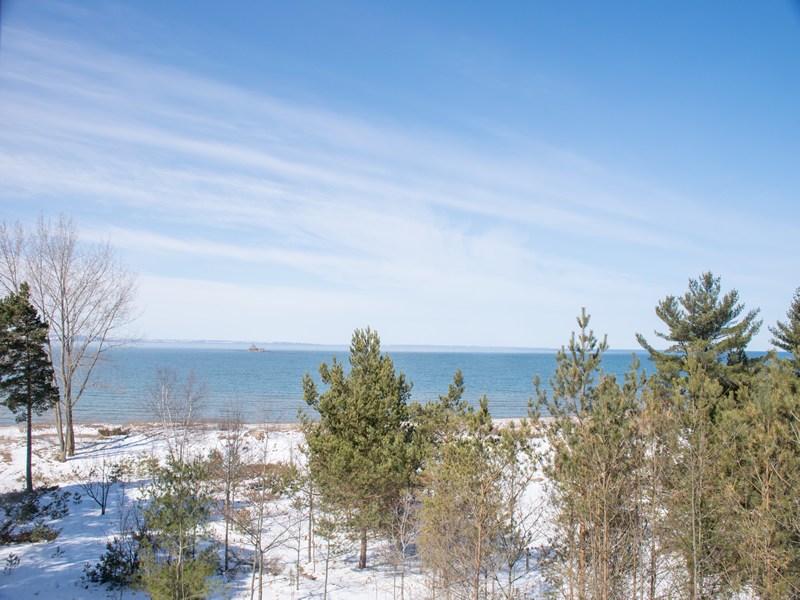
Either way, how deep a drilled well goes, and how much water it gives, is found during drilling rather than decided beforehand. That is worth knowing before you set a move-in date.
The septic bed decides how far apart they sit
Most rural lots need a well and a septic system, and the Ontario Building Code keeps them apart. The clearances are in Tables 8.2.1.6.A and 8.2.1.6.B, reproduced on the Town of Penetanguishene’s septic permit application:
- The septic tank must be at least 15 m from a well.
- The leaching bed’s distribution pipes must be at least 15 m from a well with a watertight casing to a depth of 6 m.
- From any other well, the bed must be at least 30 m away.
A drilled well with a watertight casing at least 6 m deep meets the first condition. A dug well shallower than 6 m cannot, so the bed has to stay twice as far from it. On a large rural acreage that is a detail. On a tight waterfront lot, where the shoreline setback, the bed and the house are already competing for room, 30 m can decide whether a layout works at all.
That is why, as we explain on our Muskoka cottage builders page, the septic design is one of the first things that determines where a cottage can go on a tight lot. The well belongs in the same conversation.
Buying a lot that already has a well
An existing well is worth understanding before you plan around it.
- Look at it. A wide concrete tile, 60 cm or more across, is a dug or bored well. A narrow steel pipe, 10 to 20 cm across, is almost always a drilled well.
- Find its record. Under Ontario’s Wells Regulation (Regulation 903), the contractor who builds, upgrades or abandons a well must give the owner a copy of the Water Well Record. If the seller does not have it, search the province’s well records map by address. It shows wells reported to the ministry, and there is a request form if yours is not on it.
- Check the top. The factsheet’s upgrades for a drilled well are to extend the casing at least 40 cm above finished ground, mound soil so water runs away from it, and fit a commercially made, vermin-proof cap. Every large-diameter well must have a safe cover.
- Test the water. Testing is free through Public Health Ontario, with a sample kit from Public Health Ontario or your local public health unit. It checks for E. coli and total coliforms, not chemicals, and the province says more testing is needed around events such as the spring melt.
If a well will not be used, it cannot simply be left. The regulation requires a well to be maintained or properly abandoned, which means plugged and sealed. For upgrading, replacing or abandoning a well, the province’s advice is a licensed well technician who holds, or works for the holder of, a well contractor licence.
Where to start
If you are looking at a rural lot, ask early what kind of well it has, or whether it has one at all. Find the record, look at the casing, and test the water. If there is no well yet, find out what is under the lot before you fall in love with a floor plan: rock, sand or clay will shape the well, the septic and the house.
Well drilling and septic design and installation are part of the site preparation and site development we manage on rural builds, with one team on one schedule. Our post on what site preparation involves covers the rest of that stage. Tell us about your lot and what you hope to build, and we will reply within two business days.
Frequently Asked Questions
Is a drilled well better than a dug well?
For protecting the water, usually yes. Ontario’s rural water factsheet says large-diameter wells are generally more vulnerable to contamination than drilled wells, because of leaky casing joints and how hard it is to seal around a wide casing. A dug well in sound condition can still serve well where shallow groundwater is plentiful and clean, and it stores more water.
How deep is a dug well compared with a drilled well?
A dug well is usually no more than 9 m deep, and a bored well averages about 15 m. A drilled well goes as deep as it needs to reach a reliable supply, either in sand and gravel or in the bedrock below, and that depth is found while drilling.
How can I tell what kind of well I have?
Look at the casing. A concrete tile 60 to 120 cm across is a dug or bored well; a narrow pipe 10 to 20 cm across is almost always drilled. The Water Well Record will confirm it, and you can search Ontario’s well records map by address if you do not have a copy.
How far does a well have to be from a septic system in Ontario?
Under the Ontario Building Code, the septic tank must be at least 15 m from a well. The leaching bed must be 15 m from a well with a watertight casing to a depth of 6 m, and 30 m from any other well, which includes most dug wells.
How often should I test my well water?
Regularly, so you know how much your water changes, and again after events such as the spring melt, or when the taste, colour or smell changes. Testing for E. coli and total coliforms is free through Public Health Ontario; it does not cover chemicals.