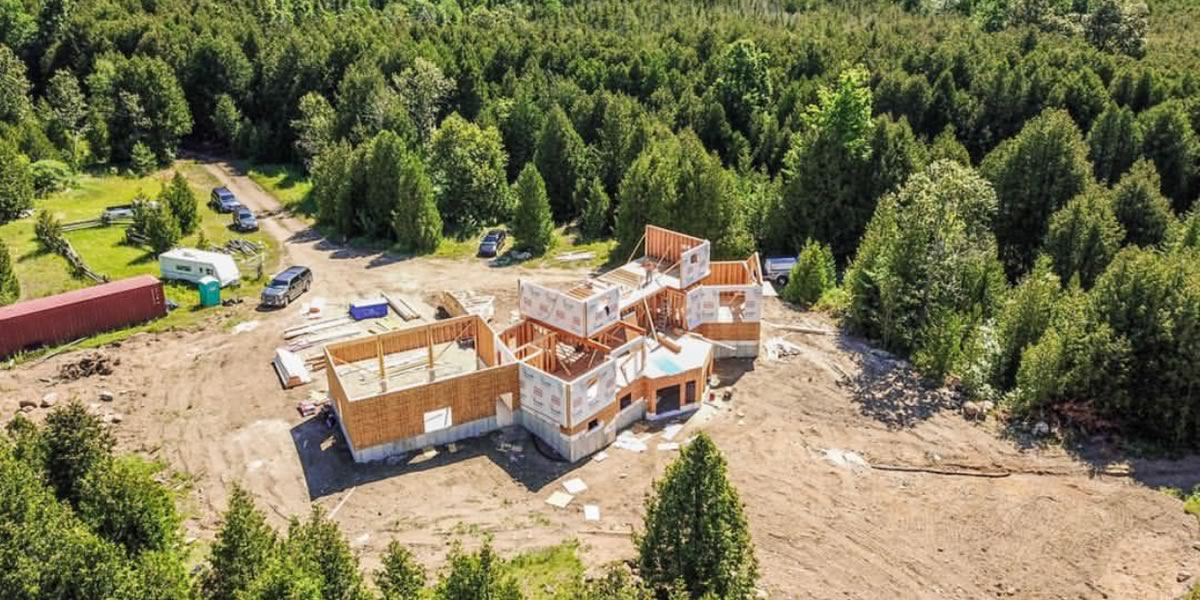
Cottage-country lots have character: trees, rock, slopes, water. That character is why you bought the property — and it is exactly why preparing it takes real experience.
Site preparation is the stage nobody photographs for a brochure and almost everybody underestimates when they budget. It is also the stage that decides whether the rest of the build runs smoothly or spends the summer working around a problem that should have been solved in week one.
Access comes before everything
You cannot build what you cannot reach.
Before a single tree comes down for the house itself, there has to be a way in for an excavator, a concrete truck, a lumber delivery and eventually a crane. On a flat lot off a municipal road that is a formality. On a sloped, treed approach it is a real piece of engineering — grade, width, turning radius, culverts where water crosses, and a base that will carry a loaded truck in April rather than swallowing it.
Driveways get built properly at this stage for a practical reason: every vehicle that comes to your build for the next year uses it. A driveway that fails in month two costs you the driveway plus the delay plus whatever was scheduled that week.
Clearing, excavation and grading
Clearing is not the same as flattening, and on a lot you bought for its character the difference matters. The trees that shelter the house, frame the view or hold a slope together are worth keeping. The ones in the building envelope are not.
Excavation follows the design, not the other way round. On the Canadian Shield that often means rock — and rock changes the sequence, the equipment and the cost, which is why it gets established early rather than discovered.
Grading is the quiet one. It sets where water goes for the life of the building, and it is far cheaper to shape ground before a house sits on it than to fix a drainage problem afterwards with a house in the way. If you are building on a slope, the sloped-lot piece goes deeper on what that changes structurally.
Well and septic set your real timeline
These two are the most common reason a rural build starts later than the owner expected, and they are worth understanding before you set a move-in date.
A well is a drilling operation with a genuinely uncertain outcome — depth and yield are found, not chosen. A septic system needs design, approval and installation, and its size follows the house: bedroom count and fixture load drive the system, which means a plan change upstream can change the septic downstream.
Neither is a formality and neither is fast. Getting them moving early is most of what separates a build that starts on time from one that waits.
Drainage, and why freeze-thaw is unforgiving
Central Ontario does not let you be casual about water. Ground freezes, thaws, heaves and refreezes, and anything that traps water near a foundation or under a driveway gets worked on by that cycle every year.
Doing drainage right the first time is not a premium upgrade; it is the cheapest version of the job. The expensive version is doing it again in three years around a finished house, a planted yard and a paved drive.
Why the whole scope should sit with one team
Site development is where builds most often fragment — a clearing contractor, an excavator, a well driller, a septic installer and a driveway crew, each booked separately, each waiting on someone else’s schedule.
We manage the full scope: clearing and excavation, grading and drainage, driveway construction, and the well and septic systems rural builds depend on. One team, one schedule, one point of accountability — which mostly means that when something on site turns out differently than expected, and on these lots it does, there is no argument about whose problem it is.
That is the same principle that runs through our whole build process, from the first site visit to the final walkthrough.
Where to start
The honest first step is a site visit. Slope, soil, rock, trees, where the water goes and where a driveway can realistically land are not things anyone can assess from a listing photo or a map.
If you have a property, or you are weighing one you have not bought yet, tell us about it — we reply within two business days, and the early conversation is the one that stops a lot from surprising you later. Full scope is on our site preparation page.
Frequently Asked Questions
How long does site preparation take?
It depends far more on the lot than on the house. Access, clearing and grading can move quickly on straightforward ground; rock, difficult approaches, and the approval and scheduling around well and septic are what stretch the timeline. It is worth starting these before you expect to.
Can you build on a lot with a lot of rock?
Yes — it is normal work in this region. Rock changes the equipment, the sequence and the cost rather than ruling a lot out, which is why it is better established during the site visit than discovered mid-excavation.
Do I need the well and septic before construction starts?
They need to be designed, approved and scheduled early because the septic system is sized to the house and the well's outcome is not known until it is drilled. Leaving them late is one of the most common causes of a delayed rural build.