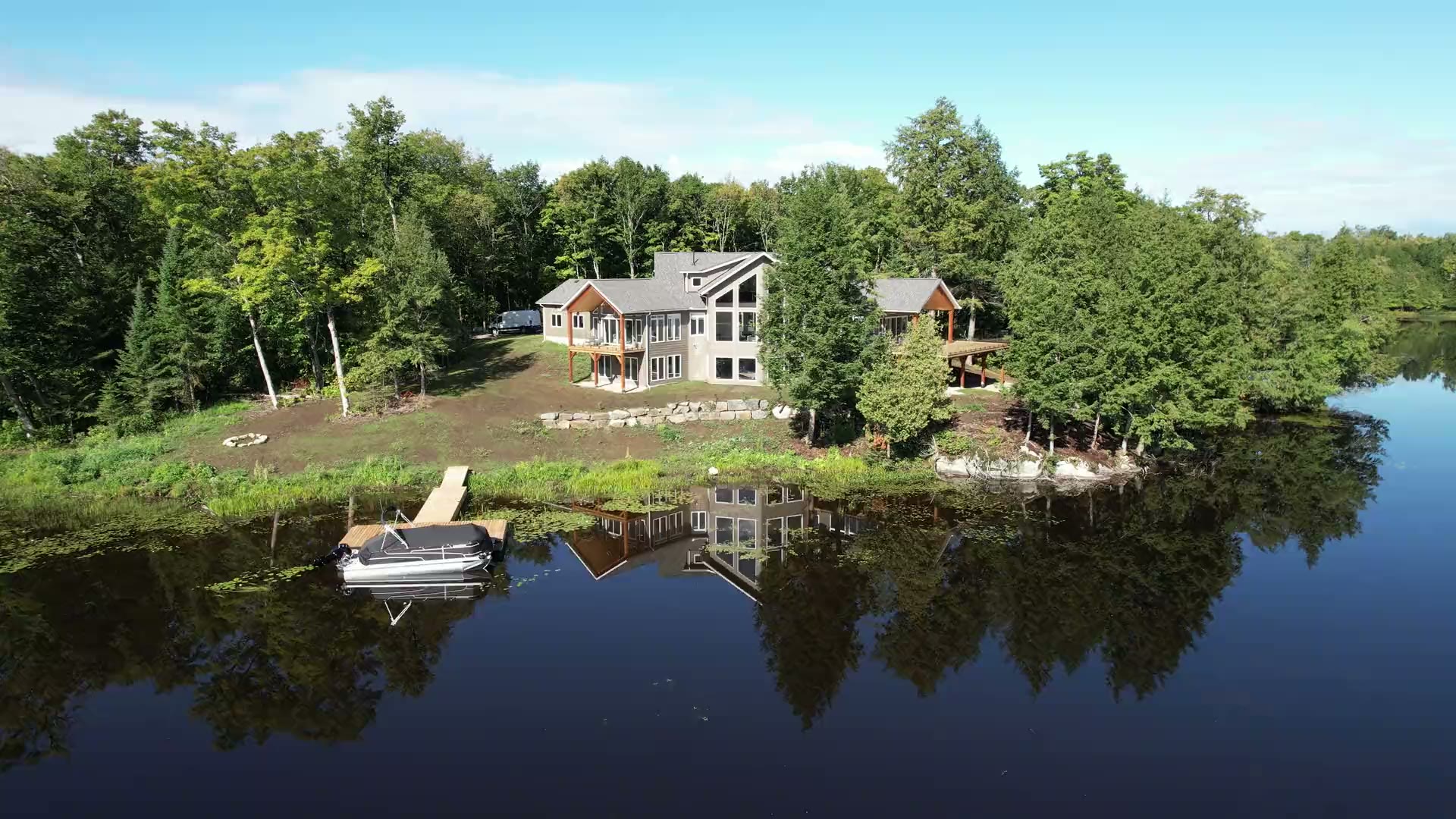
I look after site preparation and excavation on our builds, and on Georgian Bay the question of where the wastewater goes comes up early. Some lots have more rock than soil. Some are narrow strips of shoreline. When a buyer hears that a septic bed will be hard, holding tank sewage often comes up as the easy way out. Usually it is not, and the reason is in the Code.
What a holding tank actually is
The Ontario Building Code sorts on-site sewage systems into five classes. Most rural homes and cottages use a Class 4 system: a septic tank that pre-treats the wastewater, then a leaching bed that lets the effluent soak into the soil. A holding tank is a Class 5 system, which the Code defines as one that holds hauled sewage at the site where it is produced until a hauled sewage system collects it.
The province’s SepticSmart guide puts it more bluntly. A holding tank holds all household waste, provides no treatment and needs frequent pumping by a licensed sewage hauler. The same guide says Classes 1, 2, 3 and 5 have very specific and limited uses.
That is the whole difference. A septic bed returns treated water to the ground on your lot every day. With holding tank sewage, nothing leaves until somebody comes for it.
The Code only allows it in four cases
Article 8.8.1.1 of the Code is short: a Class 5 sewage system shall not be installed, except as Article 8.8.1.2 allows. That article lists four circumstances:
- A temporary operation lasting no more than 12 months. The Code specifically excludes seasonal recreational use, so a cottage used every summer does not count as temporary.
- To fix an unsafe sewage system, where replacing it with a Class 4 system is impracticable.
- To upgrade the system for an existing building, where a Class 4 system is not possible because of lot size, site slope or clearance limits.
- As an interim measure until municipal sewers arrive, provided the municipality undertakes to keep an approved hauled sewage system running until they do.
Read those carefully and a pattern shows. Three of the four deal with something that already exists or is about to change. The only one open to a new house is the interim case, and it needs the municipality to commit to the hauling until sewers come. None of them lets you choose a tank over a leaching bed because the bed would be expensive.
Why it comes up so often on Georgian Bay
A lot of the bay’s shoreline sits on Canadian Shield rock. Parks Canada, describing Georgian Bay Islands National Park, notes that in places the rock has been scoured of all soil, while elsewhere thick deposits of till support hardwood forest. You can see both on the same stretch of shore.
Soil is what a leaching bed needs, so a lot with bare rock near the surface looks like holding tank country at first glance. On a new build, though, the Code’s answer to rock is usually a different kind of bed rather than a tank. SepticSmart says that where you have a high water table, bedrock or clay, you will need a raised bed, built up with imported sand. Our post on septic system design covers how those beds are chosen and placed.
Where holding tank sewage does come up legitimately is the older cottage: an existing building on a small lot, with a failing system and nowhere left that meets the clearances. That is exactly the case Clause 8.8.1.2(1)(c) was written for.
How a sewage holding tank is sized
Two rules set the size, and the larger one wins.
First, Sentence 8.2.2.4.(2) says a holding tank must have a working capacity of at least 9,000 litres. Two or more tanks can make up that volume if they are connected so the sewage flows between them, though any part of a tank that cannot be fully drained does not count.
Second, Article 8.8.2.2 says a holding tank serving a home needs at least seven days of capacity at the house’s total daily design flow. That flow comes from the same Code table used to size a septic system, and for a house it starts with the bedroom count: 1,100 litres a day for two bedrooms, 1,600 for three, 2,000 for four.
Take one of our plans. The Laurentian has two bedrooms and 1,275 sq ft of living area. Seven days at 1,100 litres is 7,700 litres, which is under the floor, so the 9,000-litre minimum applies. Give the same cottage a third bedroom and seven days at 1,600 litres comes to 11,200, so the tank has to grow. The designer also checks the fixture count and uses whichever calculation gives the higher flow.

The arithmetic also tells you how often the truck comes. If a two-bedroom cottage really used its full design flow every day, a 9,000-litre tank would fill in a little over eight days. Real use is usually lower than the design number, but it shows why holding tank sewage is a running cost, not a one-time one.
What the tank has to have
Because the tank is the whole system, the Code puts its requirements for holding tank sewage on the tank itself and on the people who empty it:
- A built tank to a national standard. A Class 5 holding tank must meet CSA B66, the standard for prefabricated septic and sewage holding tanks, and be built so the settled solids can be completely removed.
- An alarm. Every Class 5 system needs a device that gives an audible and visual warning that it is nearing capacity. The Code says the warning has to come early enough, considering the daily flow, where the system is, and how long the hauler takes to respond.
- A vent. At least 3-inch trade size, ending at least 300 mm above finished grade with a cap, or 600 mm where the area is subject to flooding, and at least 3.5 m from any air inlet, window or door. It may tie into the house’s own venting instead, if that is done to Part 7 of the Code.
- A written hauling agreement. Sentence 8.8.1.2.(2) requires a written agreement with a hauled sewage system operator for disposal of the sewage.
That alarm rule matters more on Georgian Bay than almost anywhere. A tank on a road-access lot near a town is a different proposition from one on a lot a pump truck struggles to reach, and the Code expects the alarm to be set with that response time in mind.
Where it can sit on the lot
Table 8.2.1.6.C gives the minimum clearances for a holding tank:
- 1.5 m from a structure.
- 15 m from a well, whether or not the well has a watertight casing to 6 m.
- 15 m from a spring.
- 3 m from a property line.
Those are the Code’s numbers for the tank alone. On a waterfront lot, the township’s zoning and the conservation authority may have their own say about what goes near the shore, which is why we look at zoning and conservation authority approvals before the design is fixed. Our permits page lists zoning review before you commit to a design, or a property.
Then there is the truck. Somebody has to back a pump truck within hose reach of the tank, in every season you use the place. A spot that meets every clearance and that no truck can get near is not a usable spot.
If you are buying a lot or a cottage with one
An existing holding tank is not a problem in itself. A listing that mentions holding tank sewage is a set of questions:
- Which of the Code’s four cases was it approved under, and is the paperwork on file with the local authority?
- What is its working capacity, and does it still give seven days at the flow your plans would create? Adding a bedroom changes that number.
- Does the alarm work, and who is the hauler on the written agreement?
- Can a truck reach it in spring, when roads and lanes are at their softest?
If you plan to replace the cottage, ask the bigger question first. Clause (c) speaks of upgrading the system for an existing building, so do not assume a new house inherits the old tank. Ask the local authority early, because whether the lot can carry a Class 4 system, raised or not, may decide what you can build.
Where to start
The answer to holding tank sewage is almost always decided on the lot, not at the drawing table. Our build process starts with a site visit and evaluation, where we assess conditions and work out the best location for the home or cottage. Site preparation on our builds includes well drilling and septic system design and installation, and septic permits and inspections are coordinated with the build. If you are looking at a Georgian Bay lot and wondering what it can carry, that is a good conversation to have before you sign anything.
Frequently asked questions
Can I put a holding tank on a new cottage in Ontario?
Generally not. Article 8.8.1.1 of the Ontario Building Code prohibits Class 5 holding tanks except in four cases: a temporary use of up to 12 months (seasonal recreational use excluded), remedying an unsafe system where a Class 4 system is impracticable, upgrading the system of an existing building where lot size, slope or clearances rule out a Class 4 system, or as an interim measure until municipal sewers arrive.
How big does a sewage holding tank have to be?
At least 9,000 litres of working capacity, and for a home at least seven days of the house’s total daily design flow, whichever is larger. A two-bedroom house at 1,100 litres a day needs the 9,000-litre minimum; a three-bedroom house at 1,600 litres a day needs at least 11,200 litres.
How often does a holding tank need to be pumped?
Whenever it fills, which depends entirely on how much water the household uses. The Code sizes residential tanks for at least seven days at design flow, and every holding tank must have an audible and visual alarm that warns before it reaches capacity, set with the hauler’s response time in mind.
Is a holding tank the same as a septic tank?
No. A septic tank is the first stage of a Class 4 system and sends pre-treated effluent on to a leaching bed. A holding tank is a Class 5 system: it treats nothing, and holding tank sewage stays in the tank until a licensed hauler pumps it out.
Does a holding tank need a written agreement with a hauler?
Yes. Where a Class 5 system is installed, Sentence 8.8.1.2.(2) of the Building Code requires a written agreement with a hauled sewage system operator for disposal of the sewage.