
I look after site preparation and excavation on our builds, and the well and septic are part of that work. People buying a rural lot, or a house that already sits on one, usually ask the question as if there were a single answer. There is not. Part of where a system lands in that range is settled before the house is framed. The rest is settled by everything that goes down the drains, and everything that happens on the ground above the bed, for the next few decades.
How long does a septic system last? The honest range
SepticSmart, published through Ontario.ca and reviewed by the Ministry of Municipal Affairs and Housing, OMAFRA and the Ontario Onsite Wastewater Association among others, gives the range in one line: approximately 15 to 40 years. In the next breath it tells you how to stretch it, which is to follow its list of things to do and not do.
A range that wide makes sense once you remember that a septic system is not one thing. Most rural homes and cottages in Ontario use what the Ontario Building Code calls a Class 4 system. Wastewater runs into a septic tank, where the heavy solids settle to the bottom and the fats, oils and grease float to the top as scum. An effluent filter keeps that scum and the suspended solids in the tank. The liquid that leaves goes on to a leaching bed, where the soil finishes the job.
Each of those parts has its own clock:
- The tank needs cleaning out on a schedule, which the Code sets by how full it is, not by the calendar.
- The effluent filter should be checked and cleaned every year.
- Some systems add a treatment unit. Filtration units, for one, need their filter material replaced approximately every 8 to 15 years, according to the same guide.
- The leaching bed is the part that is hardest to put right. When a bed fails, the guide describes the repair as anything from cleaning a few lines to replacing the entire distribution system and digging out the contaminated, clogged soil.
So the useful question is not how many years a system gets. It is what makes one bed reach 40 while another is in trouble at 15.
Some of it is decided before the house is built
SepticSmart is blunt about early failure. If a system fails shortly after construction, it says, the cause may be poor site assessment, poor design, poor construction practices or homeowner abuse. Three of those four happen before anybody moves in.
The design starts with the house. Table 8.2.1.3.A of the Code sets a daily design flow by bedroom count: 1,600 litres a day for a three-bedroom dwelling and 2,000 for four, with more added for very large floor areas. Everything downstream is sized to that number.
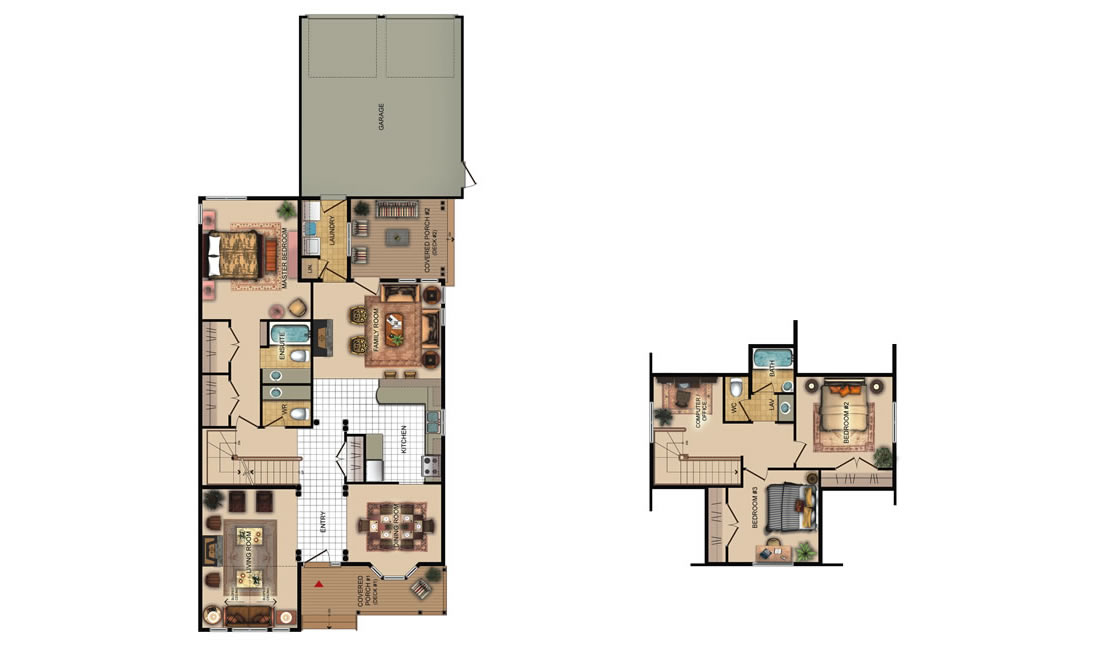
Take the Augusta as an example. It has three bedrooms and 1,862 square feet of living area, which is under the Code’s 200 square metre threshold for extra flow, so the design flow is 1,600 litres a day. Sentence 8.2.2.3.(1) sets the septic tank’s working capacity at the greater of 3,600 litres and twice the daily design flow. Twice 1,600 is 3,200, so the 3,600-litre minimum governs. Add a fourth bedroom and the flow goes to 2,000 litres a day, and the tank to at least 4,000.
Then the bed has to go somewhere it can work. Article 8.7.2.1 keeps a leaching bed off ground with an average slope steeper than one in four, and out of areas subject to flooding that could damage it. It also forbids covering a bed with material that lets water through too slowly. A bed squeezed onto the wrong part of a lot can meet the drawings and still have a short life.
This is why our build process starts with a site visit and evaluation, where we assess conditions and work out the best location for the home or cottage.
What wears a system out early
Once a system is in, most of what shortens its life falls into three groups. Each one is on SepticSmart’s list of things not to do.
Too much water. The bed was sized for the design flow, and it does not care where the extra comes from. The guide says not to connect rain gutters, storm drains or sump pumps to a septic system, and not to drain hot tub or spa water into it. It also suggests repairing leaky fixtures, choosing low-flush toilets and spreading laundry loads through the week rather than doing them all on Saturday.
Things that do not belong in the tank. Cooking oils and food waste, hazardous chemicals, pharmaceuticals, cigarette butts and sanitary products all stay out. So does a garburator, unless the system was designed for one, and water softener backwash, on the same terms. On additives sold to boost a tank’s performance, the guide is short: you don’t need them.
Weight and roots on the bed. Do not drive or park over the tank or the bed, do not pave over the bed, and do not plant trees or shrubs too close to either. The Code says the same thing in its own words: Sentence 8.9.3.2.(2) requires the land around a sewage system to be kept in a condition that will not damage it or impair how it works.

The last group matters most during and just after a build, when heavy equipment is still on site and the ground over a new bed looks like any other patch of dirt. That is when it needs marking off and keeping clear. Later on, the same goes for a delivery truck, a pool installer or a neighbour with a tractor.
The upkeep the Code asks for
Start with the tank. Its job is to hold the solids back so that only the liquid moves on to the bed. Over time the sludge on the bottom and the scum on top build up, and the space between them gets smaller.
The Code does not set a calendar for this. Sentence 8.9.3.4.(1) says septic tanks and other treatment units shall be cleaned whenever sludge and scum occupy one-third of the working capacity of the tank. SepticSmart turns that into a routine: have a licensed sewage hauler or onsite sewage system professional take the cover off and inspect the tank every three to five years, and pump it when a third of its depth is sludge and scum.
How fast your tank reaches that point depends on how many people live in the house and how they use it, which is why the inspection matters more than a fixed date. Keep the records. The guide recommends keeping an as-built diagram of the system and an up-to-date log of pumping, service calls and repairs.
One rule from the guide that is not about lifespan at all: never go into a tank. The gases and the lack of oxygen can be fatal. Keep the access lid secured to its riser.
Some systems are more than a tank and a bed. Where the lot calls for it, a treatment unit cleans the effluent further before it reaches a smaller bed, and some systems use a pump to spread the effluent under pressure. Those parts bring obligations of their own:
- Sentence 8.9.2.3.(2) says no one may operate a treatment unit other than a septic tank without an agreement for servicing and maintenance by someone the manufacturer has authorized.
- Article 8.9.2.4 requires a treatment unit feeding a shallow buried trench or a Type A or Type B dispersal bed to have its effluent sampled once in the first 12 months, then once in every 12-month period after that, with the results sent to the chief building official.
- Article 8.9.3.5 requires the pressure at the far end of a pressurized distribution system to be checked at least every 36 months.
None of these is optional, and all of them bear on lifespan. A treatment unit that is serviced on schedule protects the bed behind it. One that is ignored passes its problems along.
The signs a system is in trouble
A failing system is rarely subtle. SepticSmart lists the symptoms:
- household drains slowing down
- toilets backing up
- a sewage smell in the yard
- grass over the system that is unusually green or spongy
- bacteria or nitrate turning up in your well water
- effluent ponding on the surface
Ponding is more than unpleasant. Clause 8.9.1.2.(1)(a) of the Code says a sewage system shall not discharge sewage or effluent onto the surface of the ground. If you see effluent coming out around the tank lids, the guide says it points to a blocked effluent filter or a saturated distribution system.
The guide’s advice on what to do next is sensible. Start with an inspection, because the tank may simply need cleaning. If the problem is in the bed, talk to an onsite sewage system professional, which includes installers, engineers, certified engineering technologists and registered designers, and get a second opinion. Any repair needs a permit from the local authority that runs the septic program where you live, and that varies from one municipality to the next. Some areas also have grant programs that help with the cost.
The well is your early warning. SepticSmart recommends testing your well water for indicator bacteria at least three times a year, in spring, summer and fall.
How long does a septic system last on a house you are buying?
The age of a system tells you less than you would think. A well-kept bed at 25 can be in better shape than a neglected one at 12, so the paperwork and an inspection are worth more than the install date. Before you firm up an offer on a rural property, ask:
- Is there an as-built diagram, so you know where the tank and the bed actually are?
- When was the tank last inspected and pumped, and are there records going back further?
- Does the system have a treatment unit? If it does, who holds the maintenance agreement, and are the sampling results on file? The guide asks sellers of these systems to make sure the buyer knows the maintenance requirements.
- What does the local authority have on file for the original permit and any repairs?
- Do you plan to add bedrooms? The system was sized for a design flow, and more bedrooms raise it.
Walk the ground over the bed, too. Spongy, unusually green grass, a smell, or a driveway that crosses where the bed should be are all things to ask about before you buy, not after.
Where to start
If you are building, the longest-lived system starts with the lot. Site preparation on our builds includes well drilling and septic system design and installation, and septic permits and inspections are coordinated with the build. In our process the site visit comes before the custom design, so the lot is understood before anything is drawn.
If you already own a system, the answer is mostly in the maintenance: inspect, pump at a third, keep water and the wrong things out of it, and keep weight off the bed. How long does a septic system last in the end? A good part of the answer is up to you.
Frequently asked questions
How many years does a septic system last in Ontario?
Approximately 15 to 40 years, according to the province’s SepticSmart guide. Where a system falls in that range depends on the site assessment, the design and construction, and how well it is looked after.
How often should a septic tank be pumped?
When it needs it, which the Ontario Building Code defines as whenever sludge and scum fill one-third of the tank’s working capacity. SepticSmart recommends having the tank inspected every three to five years to find out.
Do septic tank additives make a system last longer?
No. SepticSmart lists additives claimed to enhance a tank’s performance among the things not to use, and says plainly that you don’t need them.
Can I drive or park on my septic bed?
No. SepticSmart says not to drive or park over the tank or the distribution system, or to pave over the bed, and the Building Code requires the land around a sewage system to be kept so that it does not damage the system.
Why is the grass greener over my septic bed?
Grass over the system that is unusually green or spongy is one of the symptoms of a malfunctioning system listed in SepticSmart. Have the tank inspected first, since it may just need cleaning, and call an onsite sewage system professional if the problem is in the bed.